
To better understand the concepts in this article, I recommend first reading the following concept articles:
The Spectrum of Control – Part 1
Critical Vulnerability Controls (AKA: Flow Controls)
Center of Gravity Control (AKA: CoG Controls)
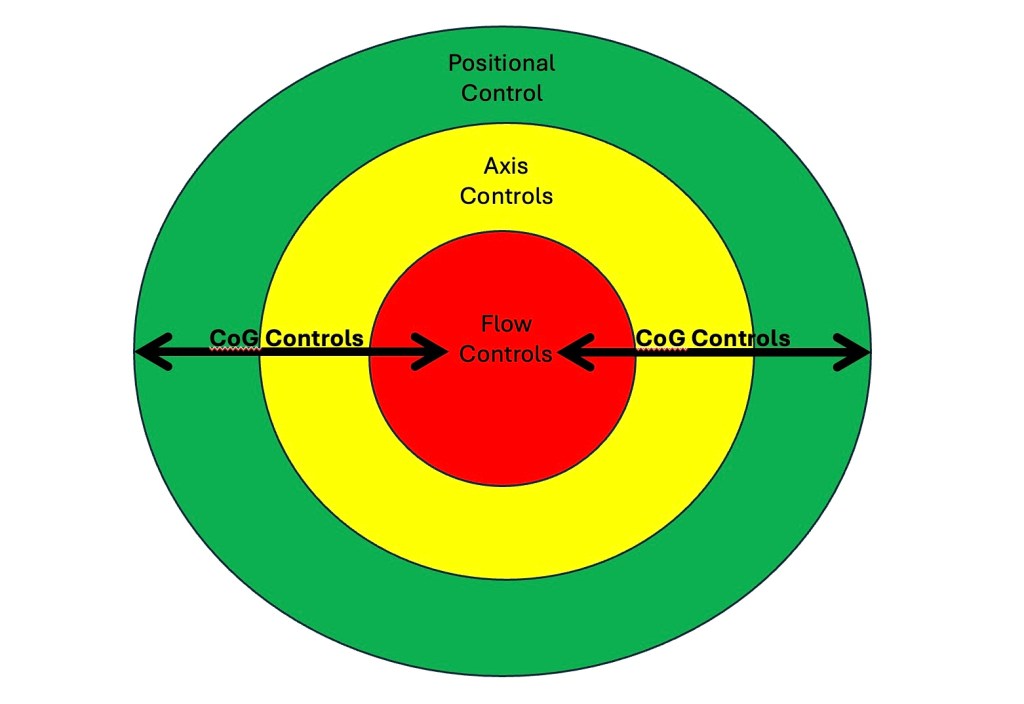
In efforts to better explain what I am trying to say, I will keep referring to the shitty art I made in PowerPoint above.
So, with all the concept stuff I have talked about, how do we fundamentally put it all together?
Step 1: Steal the Underpants Always seek positional dominance and control first.
No shit, right?
Being on top is always better than being on bottom, and being in someone’s guard is better than having someone in your guard. I’ve beat this horse already for everyone crying ‘but my guard’, and if you want to know more about why I say this, you didn’t read the articles above.
This means that, generally, I will recomend looking to improve your position as often as possible if deemed safe to do so (Notice I said if safe to do so – more on this later). Why would I stay on top of someone in side mount if I see their back exposed? Generally, we will better our position and take the back.
Step 2: ??? Gain control of as many axis’ as possible without compromising your current position and safety.
This should be the most obvious to anyone who grapples. If you pin someone’s shoulders down (upper X) from side mount but their head is free (Z), they have a better chance of escaping. If I try to control the shoulders, hips, and head it is more likely I have spread my weight too thin and will compromised my position … But the shoulders alone isn’t good enough when the head is available too.
Step 3: Profit Find Flow Controls.
Lets use the side mount example again. If I have the upper X axis pinned, along with the Z axis, I know escapes are limited but not impossible. What I need is a flow control to better cement control of an axis, which will then let me maneuver for better positions ore safely. So how could we do it?
Grab that kimura control tightly on the far side arm, stabilizing upper X axis control with more than just your weight. Now you can move to north-south and/or back mount with much more safety, moving to the right of the spectrum of control (the fundamental goal).
Continuous Step: CoG Controls – Keep on cooking them!
At every point we should look for how to pressure our opponents’ centers of gravity without compromising our positional dominance and control. By doing this, we slowly breakdown their will to continue.
Example 1: While in step 1, we continuously look for ways to throttle their power by taking take their spine out of alignment. This makes it harder for them to fight us off as effectively, leading us to step two much easier.
Example 2: While in step 2, (side mount scenario) we look to not only give a hard cross face to throttle the upper X axis, but we also use our weight (elbow too?) to restrict breathing in the chest, attacking the bodies currency. We can also pull the far side arm in the opposite direction of cross face to initiate more power throttling. We could also put our cross face into the neck, attacking the supply line. All of this breaks the opponents will down through power throttling, taking them to the bank, and hitting their supply line. Cooking them like this makes it easier to get to step 3.
Example 3: While in step 3, we have a far side kimura flow control in side mount. At this point we have many options. We could use our shin on the opponent’s neck, attacking the supply line while also throttling their power – all while maintaining our flow control. We could also slide to north south (improving position), maintaining their head looking towards the flow control side to keep throttling the upper X axis. We could also continue around to gain side mount on the other side, then taking back exposure (improving position), then looking at this all over again!.
Now to rant…
Too often I see beginners give up the fight for a dominant position, accept the inferior one and say, “this is where my game is” (This shouldn’t be allowed with beginners– read guard-is-not-for-beginners). The truth is no one ever taught the beginners a general way to approach looking at these positions or gave them framework to evaluate their decision making so they can minimize risks, gain/maintain tempo, and stay safe.
If I were to walk up to you during a round while you are in a dominant position, just chillen out, and you cannot answer the questions “what’s your goal from here” or “what is your plan from here”, you are basically fighting a war without a strategy despite whatever tactics (or luck) got you to that point.
To quote Sun Tzu, “Strategy without tactics is the slowest route to victory. Tactics without strategy is the noise before defeat.”
Your techniques and setup are your tactics. For your strategy, I offer you this general framework.
Note: Some positions that are deemed higher in the positional hierarchy (Mount over North-South, for example) are not universal depending on size/strength of each participant. Most of the time a 100lbs opponent is much safer in the top of North-South on a 300lbs opponent than on top of them in mount – I’ll write more about this in another article.
Note: It is not always advantageous to better your position if you have positional dominance, sufficient control and tempo in the engagement. There is a reason you see most higher-level MMA fighters opt not to gain a more dominant position (hierarchically) while on top, reigning blows (tempo) down in their opponents half-guard (sufficient control). Why would they? They have sufficient lower X control (thanks for the hip half guard) and the opponent usually can’t do shit but try not to get hit.
Recommendation:
In summary, we should have a fundamental positional framework – a general gameplan. Without this, practitioners feel lost in rolls, lost in what to focus on, and make bad tactical decisions. Use this framework for your strategy, or make your own. Just ensure that your tactical decisions support your strategy so that your risk exposure (movements) are not needless/pointless without aim.
Mathematical Jiu-Jitsu emphasizes frameworks within its instruction to better digest and utilize the doctrine and concepts taught within. The purpose is to ensure students are equipped to evaluate situations and act with unifying efforts for maximum results.
 Mathematical Jiu-Jitsu
Leave a comment