
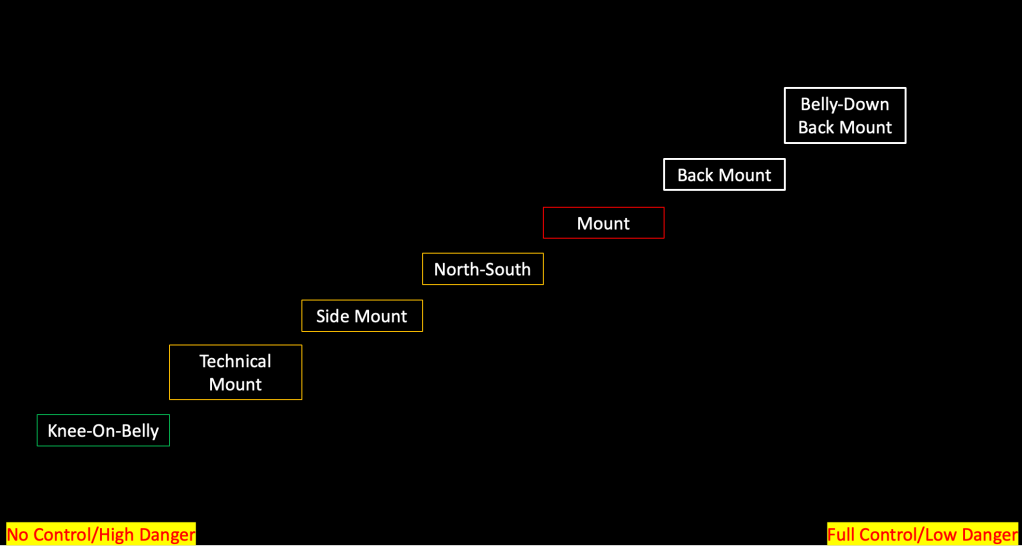
Example of The Spectrum applied to top positions
In Mathematical Jiu-Jitsu, fundamentals emphasize control above all else in effort to keep the practitioner safe as well as the opponent. Every decision should begin with how much control and danger you are exposed to from your position, and every movement should be based on advancing to more control and less danger exposure. Where you exist in this is a spectrum that I often reference as “The Spectrum of Control”.
I created this spectrum based on three criteria:
- Axis and space control.
- Opponent weapon control/directionality
- Personal weapon availability
Axis and Space Control
We see the body as operating on four axis’ (critical vulnerabilities) that we seek to control.
- Lower X axis – The hips (hip line)
- Upper X axis – The shoulders (shoulder line)
- Y Axis – The spine
- Z Axis – Where the head looks.
Each one of these control power generation, movement, and the opponent’s ability to create effects. The more we control these, the more we degrade their capability to be offensive or defensive (more on the specifics of each and what they do in another post).
Controlling these axis’ requires limiting the opponent’s space to generate power to resist our control as we seek to exploit via mechanical advantage (its all angles and weight!).
The closer we can get while controlling these axis’, the less ability they have to act.
Opponent Weapon Control/Directionality
We aim to not let their weapons face us. What does this mean?
Weapon: anything they would use to inflict injury on you in the situation. Arms and legs, in some cases head, shoulders and others are a weapon.
Example: If an opponent is in my closed guard, his weapons (arms) are pointed right at me (his upper X axis is not controlled, and his arms can now punch me in the face). If my opponent were to turn around in my closed guard, even though I don’t control his upper X axis, he still cannot punch me in the face because he must turn around to do so. In this, we controlled the directionality of his weapons.
If I were to grab his wrist and trap it to his body, I will have taken control of that weapon. Ideally, we have directionality control and weapon control to stay safe from an event where we lose control of the weapon.
Personal Weapon Availability
Having more weapons to use than your opponent is better than less. If I can trap both of his arms with one arm, I have one free to attack with. The goal is always to unbalance this to our favor.

Worst-Case Scenario
On the far left of the spectrum, we have the worst-case scenario: when we have no control and high amount of danger as such. If the opponent is under no form of control, they can use the space they have to generate power and harm you. In this case, if you cannot run, you you’re your weapons (your limbs) to defend yourself from direct attacks such as punches to the head.
Best Case Scenario
On the far right of the spectrum, we have the best-case scenario: We have more of the opponent’s axis under control, taking their ability away to create space and generate power. If they cannot generate power to use their weapons towards you, they cannot immediately hurt you without having to change their position in space. If their opponents’ weapons are under control and more of yours are free, you are truly in s superior position.
Simple idea of what I am saying…
If you can touch your opponent’s face and they cannot touch yours – this is a good sign!
If they opponent can touch your face and you cannot touch theirs – this is a bad sign!
Best-Case Position: Belly down back mount on an opponent
Upper X: Smashed into ground – directionality of weapons facing away.
Lower X: Completely controlled
Y: Bent out of alignment (more later) by our hips.
Z: Facing away from us
Both our hands are free!
Worst-Case Position:
That is done to us.
Mathematical Jiu-Jitsu emphasizes the spectrum of control and the three criteria in order to teach the practitioner to evaluate and act methodically while preserving their safety as much as possible. This is fundamental to every decision we make in engagements.
 Mathematical Jiu-Jitsu
Leave a comment