
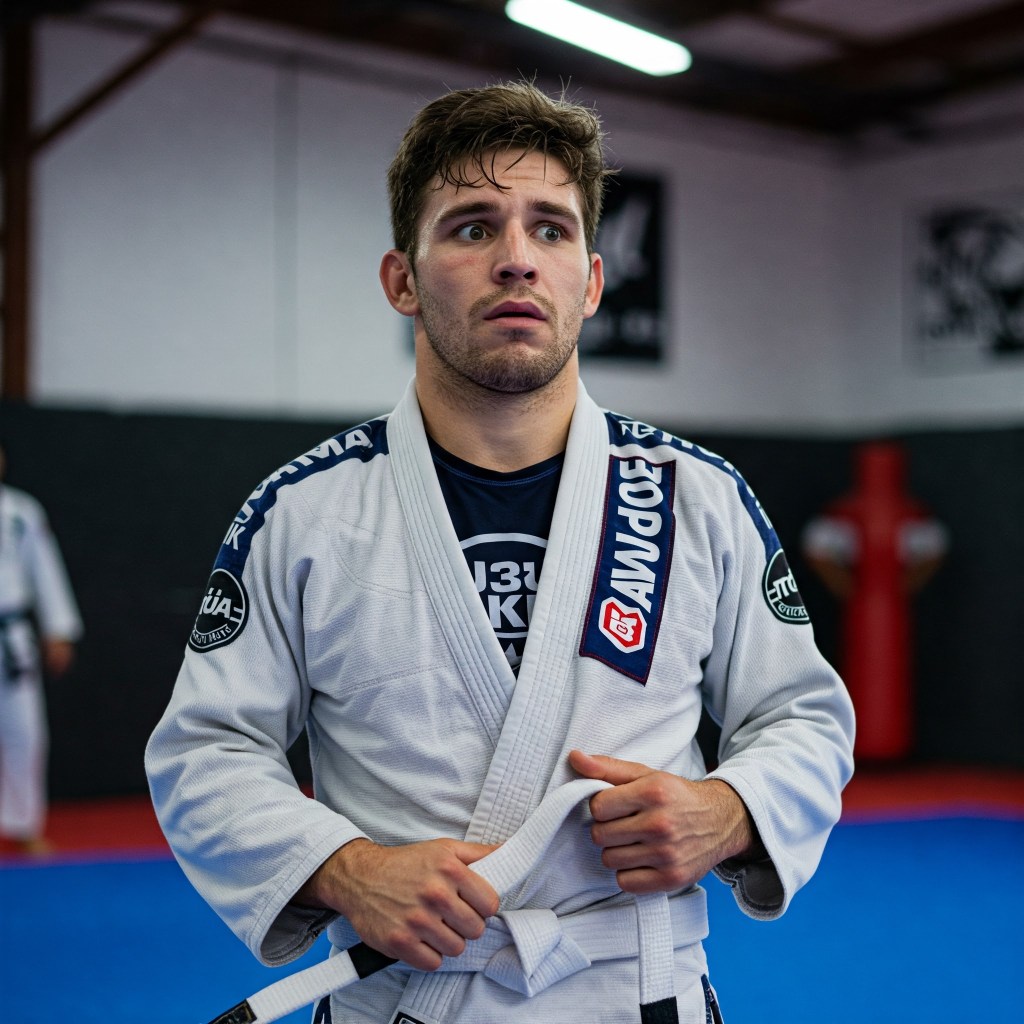
Beginners Shouldn’t Train in a Gi!
Before I get into my viewpoint, lets first look at a few definitions…
The definition of ‘simple’ as an adjective according to the Cambridge Dictionary is:
“without unnecessary or extra things or decorations; plain”.
The definition of ‘fundamental’ as an adjective according to the Cambridge Dictionary is:
“being the most basic or most important thing on which other things depend”.
So, what does this have to do with Gi vs No Gi for the beginner grappler?
Let’s imagine you are an instructor at a grappling school and a person walks in saying they want to start classes. Reasons will vary, but at some level every beginner that walks in wants to learn to better defend themselves. While it may not be a primary reason for everyone, it is a reason for everyone, or they could have picked up something much easier on the body.
Wouldn’t you agree that they need to start with fundamental classes?
The problem with “fundamental” is that no one seems to agree what fundamental means (I will write on this exact topic later) and throw them in their class with a loaner Gi and think nothing about it. I will absolutely argue that this is the opposite of what we should be doing for anyone that is new to grappling.
Fundamentals are supposed to be the most basic (simple) techniques that everything else depends on. I have plenty to say on this specific topic of how no one teaches fundamentals anymore, but I will save that for another time since this is about the Gi…
What will inevitably happen is a new beginner will learn things like collar chokes, collar sleeve, grips to slow things down, etc. In Gi Jui-Jitsu, this is often accepted as fundamental. The truth is you are hurting your new students when you do this.
Let’s say John starts training at your academy as a brand-new grappler. He watches MMA and has decided it’s time to learn this to get in better shape, learn to defend himself, and have a hobby. Months fly by and John has spent hours on the mats in a primarily Gi focused classes so he can see blue belt. He has developed a good guard and has excellent guard retention, lasso guard, and some nasty loop chokes. He feels confident as the white belts and more junior blue belts now have a hard time with him.
The day comes and he earns his blue belt. He now has demonstrated that he can survive and has basic offensive skills as determined by his head instructor. Of course, he is going to feel great and more empowered. Chances are he has lost weight on the way, found a new community to bond with, and the blue belt around his waist is a testament to his ability to grapple and defend himself.
John one day finds himself after work in a parking garage and is fumbling to find his keys. Since he got off late, everything feels rushed and out of order. Seeing John fumble, a man comes up and threatens violence for John’s wallet. Fortunately, John is a blue belt and should be able to handle himself, right?
Well, as the fight hit the ground, those sleeve grips aren’t working because a Gi is much thicker and doesn’t rip. That loop choke he is known for in his school isn’t working because the t-shirt the man is wearing isn’t sufficient to execute the choke. The man is on top swinging, becoming more aggressive and violent so John resorts to trying to cover up and use closed guard. Unfortunately, the mans aggressiveness is pushing past John’s ability to retain the guard because those grips he relied on to slow this aggression down in the school are not available. John gets his ass kicked at best.
How did we get here? There are many problems that led to this place, but the only thing I want to focus on right now is how the school failed him in so many ways – and specifically with the Gi.
Putting a beginner in the Gi and allowing a reliance on the Gi leads to a false sense of grappling capability and is dangerous.
I believe all grappling should start without the Gi. We must explore and gain comfort in how to grapple and control in absence of dense clothing or we risk the above scenario. The same head control that works without a Gi will also work in a Gi – this is fundamental. All controls and submissions in No-Gi work in Gi, but it does not work the other way. We must focus on what works without dependence on clothing in effort to not only ensure our students are well taught, but also so that they can defend themselves.
From a curriculum standpoint, introducing the Gi to beginner is introducing complexity. For the sake of argument, let’s pretend there are only 100 techniques in No-Gi. We know all these transfer into Gi based grappling. If we throw on a Gi, we just increased the total amount of techniques at least 100% through all the new types of lapel tricks, grips, etc. This means we added another layer of complexity and techniques into the system we were trying to impart on our students. This is not fundamental and should be meant for more advanced training.
Fundamentals need to stay fundamental. While I will argue what is fundamental later, at the very least it is not in a Gi for a beginner grappler that just walked in your school.
To summarize: You are not helping the beginner grappler to defend themselves by allowing them to learn and rely on a Gi. You are also not giving a beginner grappler fundamentals of grappling by teaching them to use a Gi where additional complexity exists. However, no one will argue against beginner grapplers should train in fundamental classes.
Mathematical Jiu-Jitsu focuses all fundamental training in No-Gi and reserves Gi training for the Intermediate and Advanced classes.
 Mathematical Jiu-Jitsu
Leave a comment